Jenny Pope
Jenny Pope is an Edinburgh based artist, with a BA in Ceramics and an MA in Sculpture from Edinburgh College of Art. She creates sculptures and installations using found and recycled materials playfully responding to challenging contemporary issues, creating space for reflection which question our responses to uncertainty.
She exhibits widely in the UK, recently including installation at St Mary’s Episcopal Cathedral, Edinburgh (2024), Creative Scotland funded residencies with Art Walk Projects (2019-21, 2023), Material Truths, Royal Society Sculptors, Scarborough (2024), SSA commission for annual exhibition Edinburgh (2022), Bursary winner for John Muir Open, Dunbar (2019).
She has received professional development awards including VACMA, exhibition prizes and had residencies in Seville and Almeria, Spain.
Her current focus is her Creative Scotland Individual funded art/citizen science project Shoogly Holm, in Orkney, part of her ongoing practice based research centring her commitment to climate activism to make a difference in the face of the current emergency.
She is a professional member of Scottish Society of Artists and is elected to the Royal British Society of Sculptors. She has had extensive experience working in mental health, latterly as a coach and mentor with creative people and as co-lead on SSA mentoring programme.
Activity facilitated group 8-12 people, length 1 to 1.5 hours depends on group.
Materials – a selection of clean recycled packaging, eg toilet rolls, brown paper, boxes, string, wool, Spare craft materials, magazines, coloured paper.
Tools – different types of sticky tape, scissors, paperclips, staplers.
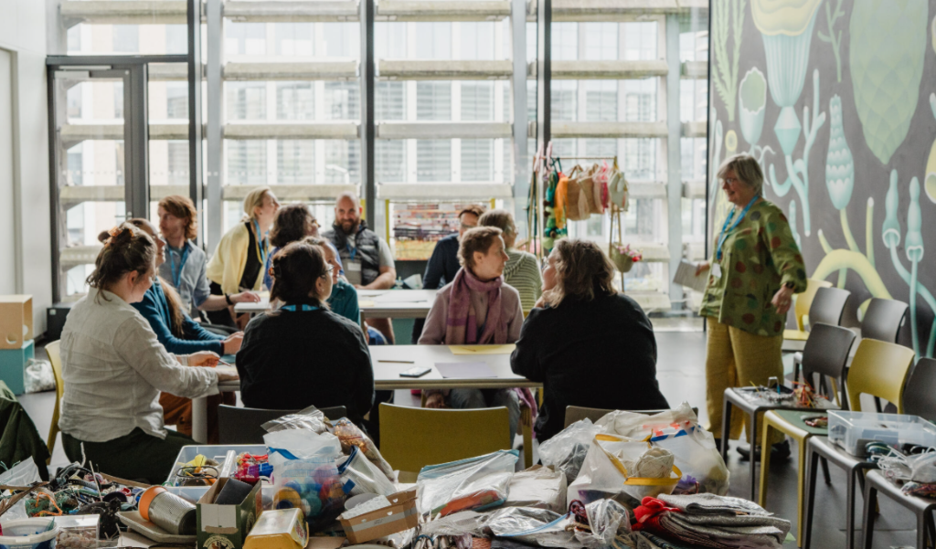
Space required – a room with tables for everyone to sit around, and space to work on. Also a table to lay out materials and tools.
Skills of facilitator – someone with wellbeing/facilitation/ groupwork/coaching skills and creative craft /making skills in 3D forms.
Plan for workshop
Introduction, share names and one thing you are grateful for.
Facilitator to explain background of artist, Jenny Pope and her project Buoyancy in uncertain times.
Watch video ‘adrift, response’ ( 7 mins long )
Discussion ( 10 – 30 mins depending on group )
Questions to ask group, choose from some of these, not all of them!
- What words come to mind to describe how you feel watching video?
- What is a metaphor ? describe one you know already.
- Why did artist use buoyancy as a metaphor?
- What does the word ‘adrift’ mean to you, and how does this relate to climate crisis ?
- What does the word ‘response’ mean to you and how does this relate to climate crisis?
- What uncertain journeys do you think we face ?
- How might communal action help?
- What role does singing play in the beach event ?
- What do poems add to events?
- The last line of the poem ‘New lands will rise like growling whales’ what could that mean in this context?
- What is the importance of ceremony in this event, what does it remind you of?
- What are the audience contributing and also getting from being here?
- How do the people involved here feel about the sea?
- Which part of this is art? The boat? The poem/ songs, the audience, or the whole experience?
- Any other comments or ideas that you want to share?
Practical activity (30 mins)
To start thinking about climate emergency and how we feel. Using the artists concept of floating as a metaphor for hope, ask group to choose some materials from the table, and to make a model of a floating boat form themselves.
This could be a paper boat, a folded origami one or more elaborate. Or an abstract floating sculpture.
They can use plastic packaging as a starting point, adding decoration.
They can then write on the piece some words or text about Hope, and what things they hope for
Ask group to say why they have made their piece, and share any words they have added.
Ending activity for session. ( 5 mins)
Each person to have a few minutes to think of something they can do, as a positive action to enable them to feel more hopeful, or useful in the face of uncertainty.
What audiences will get from it
Time to think about hopefulness, and what it means to them. How art can be used to bring people together and explore ideas. Time to make an object and think through how hope relates to them personally.
Suggested adjustments for younger audiences
If you are working with children or young people, you need to pay attention to not exacerbating any anxiety they may already have around climate crisis, so choose words that you feel will be thought provoking and appropriate to their age group but not alarmist. Being playful and creative can allow them to express feelings that do not necessarily need explaining in words. Another option is to get them to work in groups of 2-3, to allow them to support each other and less confident ones can feel safer. You could end as well with going over how the school or club etc is already involved in positive climate actions and remind them how to get involved or where to take new ideas.