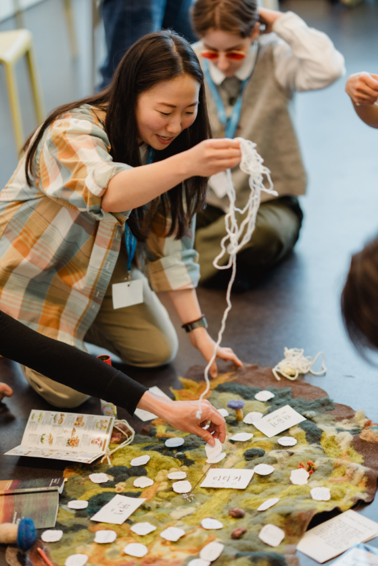
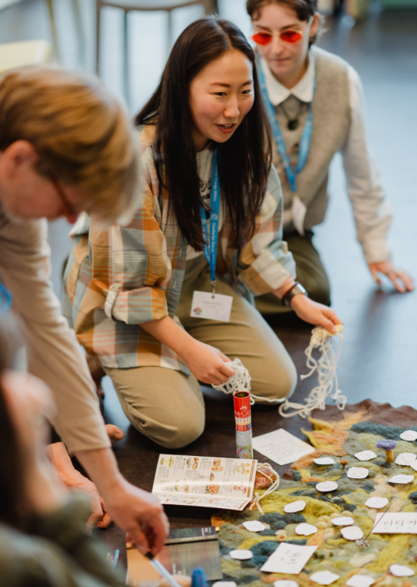
Haeweon Yi
Haeweon is a theatremaker, writer, and researcher from Korea, based in Manchester. She creates theatre focusing on playfulness, bodies, objects, puppetry, and communities, with sustainability at the core of her practice. Her work aims to share the lesser-heard voices of the more-than-human world, both inside and outside theatre spaces. In 2015, she co-founded the participatory theatre company Blooming Ludus with Francine Dulong, addressing climate justice and environmental issues through community-based practice in the UK, Korea, and Canada. Her particular interests lie in the protection of biodiversity, the decolonising of the climate discourses, sustainable art-making, and fungi and lichens, underpinned by a background in stage directing and community-based practice.
Her PhD research at the University of Manchester explores human–fungi relationships, nurturing the performance practice Theatre of Decomposition. It reimagines decomposition and multispecies co-dwelling through mourning and celebrating within the meshwork of the ecological crises. The research draws on performance practice and ethnography from year-long fieldwork conducted in Mi’kma’ki (Nova Scotia, Canada), alongside citizen scientists, forest protectors, fungi, lichens, and other nonhuman companions of the old-growth Wabanaki forests.
This workshop introduces Theatre of Decomposition (ToD), Haeweon’s performance practice that uses somatic and poetic exploration to navigate fungal imagination. It is a guided practice, not a performance. There is nothing to demonstrate or get right. The facilitator’s role is to hold a slow, attentive space where people can encounter their bodies, each other, and the fungal world around them. Participants are invited to redefine decomposition as a creative practice. In doing so, the workshop offers a way to hold the difficult emotions of ecological crisis—grief, helplessness, precarity, disconnection—alongside celebration and resilience.
For a group of 10-15 people (depending on the space size)
- Duration: 120 mins
- Materials: Haeweon’s letter to the participants (artist introduction), poems and pieces from Haeweon’s fieldnote (This will be provided in a form of QR code or PDF), fungi and lichens ID books, square paper for origami (one each for participants, 15cm*15cm or bigger), a piece of large brown paper (A0 size or a big roll for a group work), pencils/pens, charcoal, scrap paper, string or yarn, scissors (if needed). I encourage all materials to be compostable or recyclable.
- Ask participants in advance to wear comfortable clothing for gentle floor-based movement. Bare feet preferred.
- Space: Indoor studio space that is clean and safe for floor movements + (optional) access to outdoor green space
Plan for workshop
Check In (15 minutes)
- Participants share their names and introduce their fungi/lichen of the day using species ID books.
The Story From Mi’kma’ki (20 minutes)
- Participants look through materials containing Haeweon’s fieldnotes, poems, and a video that introduces how citizen scientists are collaborating with fungi and lichens in Mi’kma’ki (NS, Canada) to save the old forests. While exploring the materials, participants discuss what they want to protect and what it means to stand up for land.
- Participants make an origami tent, thinking of the land or a place they want to protect.
- After making their tent, give it a name and place the tent in the space where they feel the most connection.
Di-di-ghi (20 minutes)
- Participants stand in front of their tent feeling how their feet touch the ground.
- Introducing di-di-ghi: In Korean, di-di-ghi (디디기) means firmly placing your feet on the earth. The practice is inspired by hyphae—the tubular threads that make up the mycelium of fungi. When a spore lands on a suitable surface, hyphae begin to grow from it, anchoring into the substrate and extending outward.
- Imagine the land or a place where you set the tent. Imagine that you are standing there, now. How do your feet touch the land? Is it soft? Wet? What is the texture like?
- Now, slowly start walking. As you walk, the landscape will open up with your body. Feel the topography, change of the texture and contour, and how you become part of the landscape.
- Visit the area in the land with the strongest energy, somewhere memorable to you, or somewhere you feel most connected. Feel what emotions emerge. Visit the area that is most vulnerable on the land, somewhere facing the crisis, going through lots of changes, or you worry about for any reasons. Feel what emotions emerge.
- Pick a companion of the land to follow. It could be a human or nonhuman. After following some distance, you can choose someone else, who were there before you arrived on the land. Remember that you are the last one to arrive on that land.
- Stand where your companion led you. Slowly lower your body to lie down.
Shui-ghi (15 minutes)
- Shui-ghi (쉬기) in Korean means breathing, resting, and making time and space for microbes to do the work of decay. The practice is inspired by spores—the tiny units fungi use to disperse and reproduce, much like the seeds of plants
- Give your body a full rest. Drop all your tension and let the air and gravity hold you gently.
- Every time we breathe in, spores enter our body with the air. With each exhale, spores travel out. We are part of their journey. When we think of the fungi and millions of other microbes that live inside us, we begin to sense that our body is not a single, isolated thing, but it is another ecosystem.
- Now follow your inner fungi, or the spores travelling in and around you. Feel the weight of your body and how gravity holds you. Just like spores, move with help of air, water, surfaces, and other bodies. Spores don’t only move slowly. Play with your speed.
- Shui-ghi is also about making space for other bodies. Move while acknowledging other bodies in the room. Enjoy travelling together, and then disperse.
Deo-deum-ghi (25 minutes)
- Deo-deum-ghi (더듬기) means fumbling and groping. The practice of deo-deum-ghi is inspired by mycelium—the network that hyphae form as they constantly fuse and branch.
- While moving, keep in mind the landscape we created together in the beginning. Retrace the landscape with your tentacular senses. Just like water and nutrients flow within mycelial networks, think about what is passing through your body, feeding back into the ecosystem.
- Focus on ‘fuse’ and ‘branch’. See how your curiosity and urge to nourish yourself and your surroundings lead you. As you touch the land, think of what you can decompose within the history of this land.
- When you meet other bodies in the space, you can start fusing and branching together. Expand your body with other bodies and explore within that expansion of the body. Celebrate.
- After exploring, together find a place to grow mushrooms. Some mycelia grow into “fairy rings”—a ring of mushrooms rising together from the same mycelium. Rest. Back to your breath.
Mycelial poetry (20 minutes)
- On brown paper, participants work on a collective charcoal drawing to document the movement. Make your hands lead, and try to remember the texture of movements, how we fused and branched.
- Spores of words: On the drawing, we will add words that came from the workshop experience. Place it where you like.
- How can we reimagine co-dwelling?
- Together, we create a visual poetry of mycelium. Feel free to use scrap paper, string/yarn, and writing tools. Together, read the collective poem
Check Out (5 minutes)
- Share what you want to decompose from today’s shared moments and give a gentle goodbye.
What audiences will get from it
Through this activity, I hope participants rethink decomposition as a creative, connective process they are already part of—one that resists extractive and colonial ways of relating to the land. By meeting fungi and lichens as companions, participants can hold their difficult emotions through the body. The purpose is not to resolve the feelings, but to compost them—letting them break down into something that nourishes what comes next.
Suggested adjustments for younger audiences
An outdoor session to meet fungi and lichens in person is essential for this group. Facilitators should check in regularly and stay attentive to participants’ emotions, and should avoid difficult or traumatic histories. Guide young participants towards places they already have a connection to: a garden, a local park, a route they walk often, or a place tied to family or homeland. Use simple, accessible language rather than scientific terminology, and focus on helping young participants celebrate their encounters with the fungal world.
Background
Fungi: An enormous kingdom of living organisms that is neither plant nor animal, ranging from microscopic yeasts to mushrooms, moulds, and the sprawling underground threads called mycelium. Fungi are essential decomposers, recyclers, and partners to almost every ecosystem on Earth.
Lichens: Composite organisms formed through symbiosis—a close, mutually sustaining partnership—between a fungus and an alga or cyanobacterium, producing a single body that can grow on rocks, bark, soil, gravestones, or rooftops.
Decomposition: The natural process by which dead plants, animals, and other organic matter break down and return to the soil, making nutrients available for new life. Fungi have been central decomposers throughout the planet’s deep geological history.
References:
- Entangled Life by Merlin Sheldrake (Bodley Head, 2020)
- Underground Lovers: Encounters with Fungi by Alison Pouliot (NewSouth Publishing, 2023)
- Fungarium by Ester Gaya (Big Picture Press, 2020)
- Lichenpedia: A Brief Compendium by Kay Hurley (Princeton University Press, 2024)
- Waking Ground by shalan joudry (Gaspereau Press, 2020)
- The Magic of Mushrooms: Fungi in Folklore, Superstition and Traditional Medicine by Sandra Lawrence (Welbeck, 2022)
- The Mushroom Fan Club by Elise Gravel (Drawn & Quarterly, 2018) —recommended for young participants
- Lichen: A Beginner’s Guide to the Lichens of the World by Rob Hodgson (2025) —recommended for young participants