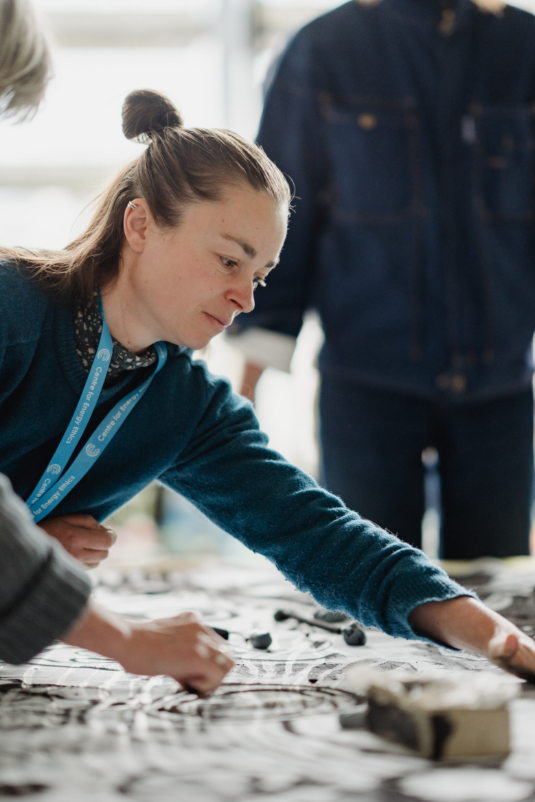
Penny Chivas
Penny Chivas (she/her) is a Glasgow-based dance artist originally from Ngunnawal Country, Australia. Working as a performer, maker and collaborator, she has performed the works of Ian Spink, Rosina Bonsu, and Theatre Cryptic.
Her dance theatre work ‘Burnt Out’ based on her experiences of the Australian Black Summer bushfires toured Scotland and England, and also internationally to Finland and Australia. Her team also implemented low-carbon methods of touring including travelling on public transport from Shetland to Dumfries. Her latest work ‘Where We Choose to Stand’ which premiered at Tramway 2025 asks audiences to consider how they may make decisions in moments of crisis and sampled interviews with activists involved in Non-violent Direct Action such as Just Stop Oil. She is currently working on a new screendance piece investigating curling as fast disappearing Scottish pastime as our climate changes. She also facilitates community and professional workshops often around climate change engagement.
Penny is a graduate of WAAPA, VCA (Hons) and the Master of Education from the Royal Conservatoire of Scotland. She is an active member in her trade union, Equity.
Activity within a facilitated group 4-16 people, length 20mins – 45mins
Materials – a selection of natural found objects such as rocks, leaves, sticks, bark, feathers and hopefully reasonably local to the geographic location
Space required – a room with space to move, ideally without any trip hazards or carpet. A recommendation of at least 4m square depending on the numbers of the group so that people feel able to move, but also not closely observed when doing so. It can be helpful to be in a space in which sitting and moving on the floor can feel inviting, such as a clean floor
Tools – A timer, such as a phone to ensure timeframes are kept. The end of an exercise could be marked verbally, eg “…and coming to a close” rather than using the bell feature on the phone.
Skills of facilitator – someone with dance or theatre, or arts, and/or somatic movement practices background. As with much work around climate change, the ability to gently hold space and to allow each participant to speak uninterrupted, alongside skills of being able to direct conversations towards actionable, or practical steps can be useful.
Plan for workshop
The session should begin with a formal opening. This could comprise of an introduction to the practices, the space (such as toilets but also any hazards or delights such as a nice floor), share names and short check-in which may include pronouns, access needs, physical injuries, and energy levels for that day. Often to reduce anxiety, it can be helpful to briefly outline the expectations for the exercise such as gentle, unguided movement with eyes closed or lowered. Within this opening, it may be possible to encourage participants to find a hand gesture that encapsulates how they are feeling on that particular day. The suggestion is here to sit in a circle and for participants to speak and gesture one by one around the circle making sure everyone is witnessed and heard. A simple hand gesture can often be a way in which to highlight the connection between feeling and movement, but also to de-mystify expectations for what a movement practice needs to be.
Part One: Working with a natural object, holding (for example sensing weight, size, texture) feeling, touching (with hands or other body parts) or even smelling. Perhaps working with eyes closed and being witnessed by another participant doing so for a defined period of time, for example three minutes before switching roles. These objects could be already brought into the room by the facilitator, or gathered by participants as part of the workshop and be as simple such as stones, leaves, or flowers. It may also be possible to encourage people to ‘gift’ a found object to another person to explore heightening the sense of connection between people.
Part Two: Half of the group moves in response to their own personal connection to the chosen natural object and is witnessed by their partners. Movement could comprise of exploring just using the hands (with or without the object), or a open up to a whole body experience. Suggested time of five to 15 minutes for each person beginning with eyes closed in the centre of the space whilst the other partner stands on the outside of the working space forming a large circle with other people witnessing. If people are moving with their eyes closed then it may be that those watching need to be aware of the space between people lest those moving bump into each other. Often saying a person’s name can be enough as moving with the eyes closed can encourage softer and gentler movement.
Afterwards: Time could be spent afterwards in discussion/reflection with the person who has moved sharing their experience before the person who has witnessed sharing what they may have seen. This could include for example remembering movement textures, sharing movement that someone particularly enjoyed or sharing any memories brought up by the activity. It can be helpful to time this part of the experience, for example four minutes each which allows people to talk and respond but also to have the space held should they for any reason choose not to speak.
The exercise could end here or could continue into more formal conversations around community action on climate change, or local environmental changes.
NB: This exercises comprises two parts, and assumes that participants are reasonably comfortable with moving (or dancing) in some capacity particularly for part two. Part one could be undertaken by many people without moving on to part two. Modifications for part two can be made including lowering eyes to look at the floor rather than closing completely, and everyone moving together at the same time (with eyes open) to support people to feel more at ease. My preference is not to use music to encourage an authentic response to the natural object which includes any sounds that the object makes on the floor or within someone’s hands, however sounds, such as natural soundscapes or simple music (such as continuos sounds) could also support people to feel more comfortable.
This exercise draws upon the practice of Authentic Movement which was originally developed by Mary Starks Whitehouse and bridges movement and dance therapy. In doing so, touches upon a deep sense of listening to oneself and witnessing this occurring within others. Care should be taken to make sure that participants can move comfortably and have access to space free of trip hazards. Ideally the exercise, whether shifting into a formal conversation on climate change or not, comes to a closure perhaps referencing the opening in which the exercise began. This can support participants to understand the shift between a safe and supported space for this activity and their next task at hand.
What participants will get from it
Witnessing Beyond Words is a way to generate movement in relation to the natural world. By taking an object and being with it, exploring it, turning it over, sensing it as it is, this is simple way to access embodied, physical responses to the changes we see and are part of, constantly. Often introducing themes of climate change itself can immediately invoke responses akin to fear, sadness and grief and whilst these may emerge space is also given to stay with, for example, the beauty in the veins of a leaf and how that still connects to leaves falling and providing nutrients for the next generation. How can we hold space for the beauty and presence of that we still have?
Importantly the framework of this exercise is intentionally open and apart from setting working timeframes, it is also possible to use such an activity as a way to bridge into more formal conversations. The idea of witnessing people lends itself well to listening and taking time with everyone involved in a discussion, as well as the recognition that people may take longer to formulate thoughts and recognise feelings. As climate change continues, how do we make sure that everyone feels comfortable in their own way contributing to conversations around emotions, adaptability and the environmental changes themselves. Which practices lay the groundwork for everyone contributing and the time that this takes, which is arguably the basis for addressing climate justice.
Further Reading
‘Authentic Movement: Essays by Mary Starks Whitehouse, Janet Adler and Joan Chodorow’